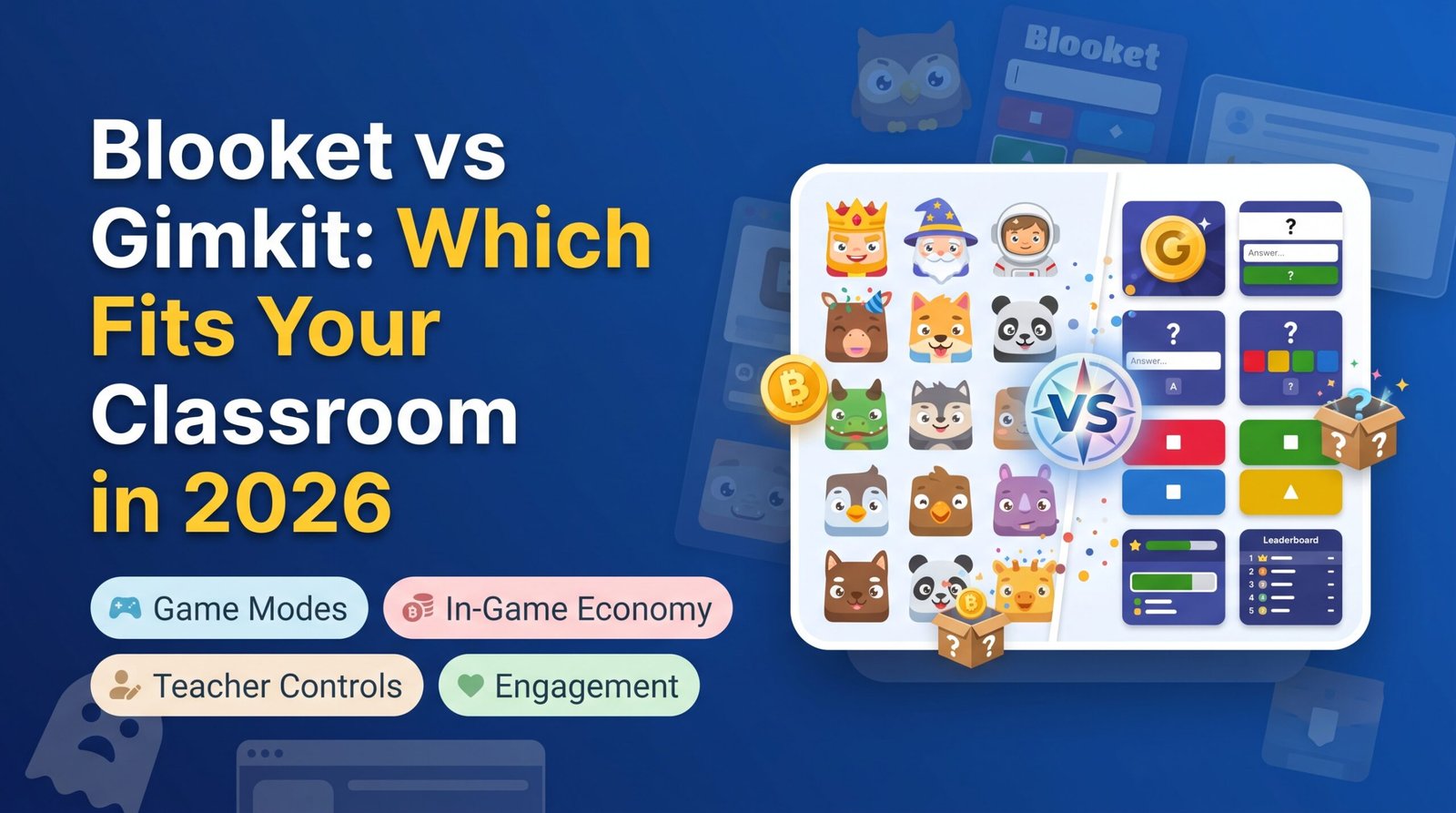
Blooket vs Gimkit: Which Fits Your Classroom in 2026
Both platforms turn a review quiz into something students actually want to play, and both were built by teenagers who thought their own classroom review games were boring. Past that shared origin story, Blooket and Gimkit solve the engagement problem in genuinely different ways, one through variety and collectible characters, the other through an in game economy students have to manage while they answer.
This comparison covers where each platform actually wins, corrects a couple of claims that circulate on older roundups, and ends with a straight recommendation based on class size, subject, and how much setup time you have before the bell rings.
Quick Verdict
| Category | Winner |
| Best free tier | Blooket |
| Best for retention over time | Gimkit |
| Best for quick beginner setup | Blooket |
| Best for older students who like strategy | Gimkit |
| Best mode variety | Blooket |
| Best student created content | Gimkit |
| Cheapest paid tier | Blooket |
In Blooket vs Gimkit, neither platform wins every category, and the right pick genuinely depends on what a specific class period needs that day rather than which tool is broadly better.
Who Actually Built These Platforms
Both tools trace back to the same origin story, a high school student frustrated with boring review games. Josh Feinsilber built Gimkit in 2016 while attending Gibson Ek High School in Issaquah, Washington. Tom Stewart built Blooket two years later, in 2018, as a high schooler in Rhode Island. The two founders have crossed paths exactly once, at a 2022 education technology conference, where by most accounts the conversation covered server costs rather than rivalry.
That shared background explains why both platforms feel built by someone who actually sat through the games they were trying to replace, rather than by a corporate product team working from a spec sheet.
Core Philosophy: Variety Versus Economy
Blooket leans on breadth. It offers around 27 selectable modes, from fast racing formats to slower strategy modes like Tower Defense. A teacher can rotate formats every week without touching the question set. The same vocabulary list or math facts still feel fresh across a whole unit.
Gimkit leans on depth within one core loop instead. Correct answers earn in game currency. Students spend that currency on upgrades, power ups, or strategic bets, which adds a management layer on top of the quiz. Fewer format switches happen day to day, but the choices inside any single game run deeper. That tends to suit older students who enjoy optimizing a system more than simply answering fast.
Game Modes Compared
| Blooket Modes | Gimkit Modes |
| Gold Quest, luck and steal based | Classic, straightforward economy loop |
| Tower Defense, strategy and waves | Trust No One, social deduction |
| Racing, pure speed, no stealing | The Floor Is Lava, elimination pressure |
| Cafe and Factory, calmer pacing | Humans vs Zombies, team based chase |
| Battle Royale, elimination format | Creative, free build 2D game worlds |
Blooket ships more total formats and keeps nearly all of them free. Gimkit’s roster is smaller but each mode wraps a distinct strategic twist around the same currency system, which is arguably why players describe Gimkit modes as the deepest of the two once you are several games in.
What the Free Plan Actually Includes
Blooket’s free plan hosts up to 60 players per live game, and the large majority of its 27 modes cost nothing to use, which covers a full standard class without any purchase.
Gimkit’s free tier gets misdescribed constantly. The common claim that Gimkit free caps out at five students is outdated. Gimkit Basic can host a full class whenever that week’s featured mode is active. It only drops to a five player cap on modes marked Pro Exclusive. Blooket still wins for a teacher who wants every mode open every day without checking a rotation schedule. But Gimkit’s free tier deserves more credit than older comparisons give it.
Pricing Compared
| Plan | Price | What It Unlocks |
| Blooket Plus | $4.99/month billed annually, or $9.99/month on Plus Flex | Higher player cap, extra modes, deeper reports |
| Gimkit Pro | Roughly $9.99 to $14.99/month depending on billing term | Full mode access, KitCollab depth, advanced analytics |
Blooket’s paid tier comes in cheaper at every billing interval, and school or department group rates exist on both platforms if a whole team is subscribing rather than one teacher. Confirm current pricing on each platform before budgeting, since both companies adjust tiers periodically.
Which Platform Actually Helps Retention
This is Gimkit’s clearest structural advantage. Its optional spaced repetition setting brings missed questions back later in the same session. A student cannot just click past a wrong answer and move on. That single mechanic means a student who genuinely does not know something gets tested on it again before the game ends. That is closer to how real studying works than one pass through a question list.
Blooket has no equivalent built in review loop, though hosting the same set again as a second short round manually approximates it. For a teacher whose main goal is making sure missed content actually sticks rather than just making review time enjoyable, Gimkit’s spaced repetition is a genuine and specific edge in Blooket vs Gimkit that variety alone cannot match.
Question Creation and AI Tools
Blooket integrates directly with Khan Academy’s Khanmigo AI assistant, which is free and can generate a full question set from nothing more than a topic typed into the teacher dashboard. That free AI generation is a meaningful time saver for teachers building sets from scratch.
Gimkit answers with KitCollab, a free feature that lets students submit their own questions into a shared set, turning review prep into a class activity rather than solo teacher work. Gimkit also offers Creative, a free 2D world building mode where students construct explorable spaces, with a paid Season Ticket layered on top for exclusive cosmetic assets. Between the two, Blooket’s AI generation saves a teacher time alone at a desk, while Gimkit’s KitCollab and Creative tools lean on student participation to build content together.
Classroom Noise and Engagement Style
Blooket tends to run louder. Live leaderboards, stealing mechanics in modes like Gold Quest, and visible on screen competition naturally generate chatter and reaction across the room, which is exactly the energy some review days need.
Gimkit’s currency system pulls attention down into each student’s own screen and their own spending decisions, producing a quieter room even during a fully live session. For a class that gets overstimulated by a loud, competitive format, or for a teacher who needs a calmer room for a nearby test in progress, that difference alone can decide Blooket vs Gimkit on any given day.
Homework and Assignment Mode
Both platforms let students complete a set on their own schedule outside of live class time, with results flowing back into a teacher report automatically. Blooket calls this Assign, generating a link students open and finish independently. Gimkit’s equivalent is Assignments, layered with the same spaced repetition logic used in live games, so missed questions resurface even in the homework format.
Feature access for homework mode has shifted on both platforms over time, so check each dashboard’s current plan details before assuming a specific tier unlocks it, rather than relying on last year’s comparison articles.
Which Should You Choose?
Pick Blooket if:
- You want the widest mode variety. 27 formats keep the same content feeling different week to week.
- Budget or approval is tight. The free tier covers a full class in nearly every mode with no purchase.
- You are new to game based review. Setup takes fewer decisions than Gimkit’s deeper option set.
- You teach younger students. Collectible Blooks and simpler mechanics suit elementary and middle school well.
Pick Gimkit if:
- Retention matters more than variety. Spaced repetition brings missed questions back before the game ends.
- You teach older students. The economy and strategy layer rewards planning over pure speed.
- You want students building content together. KitCollab and Creative turn review prep into a shared class activity.
- A quieter room fits your teaching style. Screen focused play generates less classroom noise than Blooket’s leaderboard chatter.
Plenty of teachers keep both tools active and switch based on the day’s goal rather than committing to one platform permanently, which sidesteps the Blooket vs Gimkit debate entirely by treating them as complementary rather than competing.
Frequently Asked Questions
Is Blooket or Gimkit better for younger students?
Blooket tends to suit younger students better. Its collectible Blook system and simpler mode mechanics ask for fewer strategic decisions than Gimkit’s currency management layer, which younger players can find overwhelming.
Which platform is actually free for a full class?
Blooket’s free plan covers a full class of up to 60 players across nearly all of its modes. Gimkit Basic can also host a full class, but only on the week’s featured mode, dropping to a five player cap on any mode marked Pro Exclusive.
Does Gimkit really help students remember more than Blooket?
For missed questions specifically, yes. Gimkit’s spaced repetition setting resurfaces wrong answers later in the same session, which Blooket has no built in equivalent for, making Gimkit the stronger pick when retention is the primary goal rather than engagement alone.
Can students help build the question sets on either platform?
Yes on both, through different tools. Gimkit’s KitCollab lets students submit questions directly into a shared set. Blooket instead leans on free AI generation through Khanmigo, which builds a set for the teacher rather than crowdsourcing it from students.
Which platform costs less for a paid upgrade?
Blooket Plus is the cheaper paid tier at every billing interval compared to Gimkit Pro, though both offer discounted group or school rates for departments subscribing together rather than individual teachers.
Final Thoughts
Blooket vs Gimkit is not really a contest with one final winner, it is a choice between two different strengths. Blooket wins on breadth, price, and beginner friendliness. Gimkit wins on retention, strategic depth, and student generated content. The honest answer for most teachers is to start with Blooket’s free tier for everyday review, then bring in Gimkit specifically on the days when getting a missed concept to actually stick matters more than keeping the room loud and competitive.
This is an independent guide published by Bllooket.it.com to help students, teachers, and parents get the most out of Blooket. Information is accurate as of September 2026. Bllooket.it.com is not affiliated with or endorsed by Blooket LLC or Gimkit; Blooket and Gimkit are trademarks of their respective owners.