A classroom quiz does not have to feel like another test. Blooket Host turns a question set into an interactive game where the host controls the session while students answer questions through their own devices.
Blooket describes its platform as a browser based learning tool where one player or teacher hosts the game and other players compete on their own devices. The official platform also says that Blooket has been used by millions of educators around the world.
The basic hosting process is simple, but new hosts often get confused about the Blooket Dashboard, game modes, login requirements, Game ID, and whether students need an account.
Key Takeaways
→ You need a Blooket account to host a live game.
→ Students can join without creating an account.
→ A free account can host games for up to 60 players.
→ Blooket currently offers more than 25 game modes across live, solo, and homework play.
→ The host chooses the question set, game mode, settings, and joining method.
This guide explains how hosting works, how to choose the right mode, how Blooket Play connects to hosting, how the dashboard works, and what to do when something goes wrong.
Table of Contents
- What Is Blooket Host?
- Why Blooket Host Matters in 2026
- How to Host a Blooket Game
- Blooket Play and Dashboard Guide
- Best Blooket Game Modes for Hosts
- Blooket Host Settings and Mistakes
- Blooket Host vs Alternatives
- Expert Tips for Better Hosting
- Blooket Host FAQs
What Is Blooket Host?
Blooket Host is the person who starts and controls a Blooket game session for other players. The host selects a question set, chooses a compatible game mode, adjusts available settings, creates the game session, and gives players a way to join.
Blooket’s official hosting guide confirms that the host starts by selecting a question set, choosing Host, selecting a game mode, adjusting settings, selecting Host Now, and then asking students to join through the game code, QR code, or join link.
What does a Blooket Host control?
A host controls the game setup and session rather than simply answering questions.
Depending on the selected mode and available settings, the host can manage options such as game goals, time limits, joining behavior, player names, and other mode specific settings.
The host also has access to information that players do not see in the same way. This separation is useful because the teacher can manage the activity while students concentrate on answering questions.
Does a host need a Blooket account?
Yes, a Blooket account is required to host a game, while students do not need an account simply to join a hosted game. Blooket’s official Help Center states that only the teacher needs an account for students to join using a Game ID, QR code, or link.
This distinction answers one of the most common searches around Blooket Host Game Without Login.
A student can join without logging in, but the person creating and hosting the live game needs an account.
Blooket Host vs player
The host and player have different jobs.
| Role | Main job | Account needed | Main access |
|---|---|---|---|
| Host | Runs the game | Yes | Game controls and reports |
| Student | Answers questions | No | Game screen |
| Logged in student | Plays and tracks progress | Optional | Game plus account features |
| Teacher | Creates and runs classroom activities | Yes | Hosting and reports |
| Homework player | Completes assigned activity | Usually no | Assigned game |
Quotable insight: A Blooket session works best when the host treats the game as a learning activity rather than only a competition.
Why Blooket Host Matters in 2026
Blooket Host matters because it gives teachers a simple way to turn an existing question set into a live or interactive learning session. The platform supports live games, solo play, and homework modes across a growing collection of game formats.
Blooket’s current Game Mode Previews page lists more than 25 modes and states that games can be played live, solo, or as homework depending on the mode.
How many question sets does Blooket have?
Blooket’s official Help Center says its library contains more than 20 million question sets created by users.
That number matters because hosts do not always need to create a quiz from scratch. A teacher can search the existing library by subject, grade level, topic, skill, or standard.
Our Analysis: The size of the question set library makes Blooket more useful as a discovery platform as well as a hosting tool. A new host can begin with an existing set, test the session, and later create a custom set when more control is needed.
Is Blooket free for hosting?
Yes. Blooket says its essential features are free, and its Starter plan allows hosts to run games with up to 60 players. Blooket Plus increases the general live game limit to 300 players, although some modes have their own limits.
This makes the free version practical for many standard classroom situations.
What makes Blooket different?
The main difference is the way questions are combined with different game mechanics.
The official mode list includes formats such as Gold Quest, Classic, Racing, Tower Defense, Factory, Fishing Frenzy, Crypto Hack, Monster Brawl, and Deceptive Dinos.
The result is that the same question set can feel different depending on the selected mode.
Quotable insight: The question set provides the academic content, while the game mode determines how students experience that content.
How to Host a Blooket Game
To host a Blooket game, select a question set, choose Host, select a live game mode, configure the settings, choose Host Now, and share the joining method with students. This is the official basic hosting flow.
How does Blooket Host work step by step?
The easiest approach is to follow the same sequence every time.
Step 1: Sign in
Open Blooket and sign in to the account you will use as the host.
Step 2: Find a question set
Open a set from your own collection or search the Blooket question library.
Step 3: Select Host
Open the selected question set and choose Host.
Step 4: Choose a game mode
Select a live compatible mode based on your class, subject, and desired activity length.
Step 5: Configure settings
Review the settings available for that mode. Blooket provides settings that can affect the joining process and game experience.
Step 6: Select Host Now
Start the hosting session.
Step 7: Share the joining method
Students can join through the Game ID, QR code, or join link. Blooket’s official documentation lists these three methods.
Step 8: Start the game
After the players have joined, start the game from the host interface.
Can students join without login?
Yes, students can join a hosted Blooket game without creating or signing into an account. They can use the Game ID, QR code, or join link supplied by the host.
However, students who create accounts can access additional account based features, including tracking statistics and playing solo games.
Can you host Blooket without login?
No, not for normal live hosting. The important distinction is that students can play without login, but the host needs an account.
This is why the search phrase Blooket Host Game Without Login can be misleading. If you are trying to run the session, create the game, and control the host settings, you should expect to sign in.
Blooket Play and Dashboard Guide
Blooket Play is the player side of a hosted session, while the Blooket Dashboard is where account holders manage their Blooket activity and hosting workflow.
Students joining a live game can visit the official Blooket Play page and enter the Game ID supplied by the host.
How does Blooket Play work?
Blooket Play is designed for joining games rather than creating the host session.
A host creates the game first. The host then gives players a Game ID, QR code, or join link. Players use that information to enter the session.
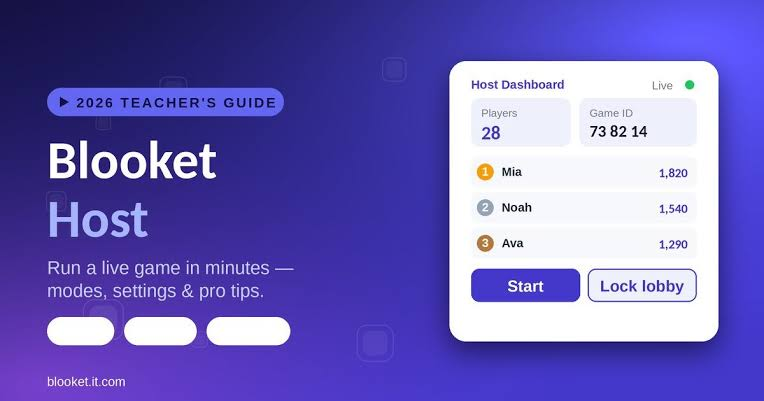
What is the Blooket Dashboard?
The Blooket Dashboard is the account area used to manage question sets, access hosting features, and review available Blooket tools.
The official teacher guide directs users to create an account, find a question set, select the set, choose Host, select a game mode, configure settings, and start the game.
The exact interface can change as Blooket updates its platform, so older screenshots may not always match the current layout.
What is the Blooket Dashboard Host workflow?
The Blooket Dashboard Host workflow can be understood as four stages:
→ Choose content
→ Choose the game experience
→ Configure the session
→ Monitor and review results
This simple model is useful because it separates content decisions from game decisions.
Our Framework: The Host Flow Pyramid
Level 1: Content
Choose the right question set.
Level 2: Mode
Choose the game mechanic that fits the learning goal.
Level 3: Control
Configure the available settings before students enter.
Level 4: Review
Use the results to identify what students understood and what needs more practice.
The framework is our editorial model based on the official Blooket hosting workflow. It is not an official Blooket product feature.
Best Blooket Game Modes for Hosts
The best Blooket game mode depends on the learning goal, group size, question difficulty, and amount of time available. Blooket’s official mode information provides suggested player counts, skills, difficulty, and ideal times for individual modes.
Which Blooket game is best for quick review?
Classic is a straightforward choice when you want a traditional quiz experience with a simple competitive structure. Blooket lists Classic with an ideal time of about five minutes and describes it as focused on speed and accuracy.
Racing is another short session option. Blooket lists an ideal time of about five minutes and describes the mode around speed, accuracy, and power ups.
Which mode is good for strategy?
Tower Defense is a strong option when you want students to combine question answering with strategy. Blooket describes it as a strategy and accuracy mode and lists an ideal time of about eight minutes.
Factory adds resource management and strategy to the question answering process. Blooket lists it with an ideal time of about eight minutes.
Which modes support solo play?
Not every mode is designed for live hosting. Blooket’s official list separates live only modes from solo or homework modes and modes that support all three formats. For example, Crazy Kingdom, Pirate Pool, Plushie Panic, Study, and Zorblitz are listed under solo or homework options, while Café, Factory, Monster Brawl, Tower Defense, and Tower Defense 2 support live, solo, and homework play.
This matters when someone searches for Play Blooket Solo. A solo player should choose a mode that actually supports solo play instead of expecting every live mode to work alone.
Blooket game comparison
| Blooket game | Main skill | Ideal time | Live play | Best for |
|---|---|---|---|---|
| Classic | Speed and accuracy | About 5 min | Yes | Quick review |
| Racing | Speed and accuracy | About 5 min | Yes | Fast practice |
| Gold Quest | Speed and luck | About 7 min | Yes | Competitive review |
| Tower Defense | Strategy and accuracy | About 8 min | Yes | Strategic practice |
| Factory | Speed and strategy | About 8 min | Yes | Repeated practice |
Source: Blooket’s official Game Mode Previews.
Winner for general classroom use: There is no single universal winner. Classic is a simple starting point, while Tower Defense offers more strategic depth and Gold Quest provides a highly competitive format.
Blooket Host Settings and Mistakes
Good Blooket Host settings reduce confusion before the game starts and make the session easier to manage.
Which settings should hosts check?
Start by checking the settings available for the selected mode.
Pay attention to:
→ Time limits or goals
→ Whether students can join after the game begins
→ Player naming options
→ Instructions shown before the game
→ Mode specific settings
Blooket’s official hosting documentation confirms that hosts can adjust available settings before selecting Host Now, including options related to joining and player names.
What mistakes should a Blooket Host avoid?
The most common avoidable problems are:
- Starting before students have enough time to join.
- Choosing a mode that does not match the lesson.
- Ignoring the player limit of the selected mode.
- Using a question set that is too difficult or unrelated to the lesson.
- Failing to review the results after the session.
Pro Tip: Run a short test with one or two devices before an important class activity. This checks the joining process, display, sound, and network connection before the entire class enters.
What if the game code does not work?
First, confirm that students are using the official Blooket Play page and the current Game ID supplied by the host.
Blooket’s official joining instructions direct players to play.blooket.com and explain that they can enter the Game ID, scan the QR code, or use the shared join link.
If a student still cannot join, check the browser connection, refresh the page, and confirm that the session is still active.
Blooket Host vs Alternatives
Blooket is strongest when you want multiple game formats around the same question content, while other classroom quiz platforms may focus more heavily on traditional quizzes or self paced activities.
How does Blooket compare with other tools?
| Platform | Main strength | Free option | Typical use | Best fit |
|---|---|---|---|---|
| Blooket | Game mode variety | Yes | Live and independent learning | Gamified review |
| Kahoot | Traditional quiz play | Yes | Live quizzes | Fast classroom quizzes |
| Gimkit | Game economy | Yes, with limits | Interactive review | Strategy focused play |
| Wayground | Quiz and self paced learning | Yes | Live and independent activities | Flexible assessment |
| Google Forms | Simple assessment | Yes | Forms and quizzes | Basic assessment |
The comparison is based on broad product positioning rather than a claim that one platform is universally better.
Which platform should you choose?
Choose Blooket when the game experience itself is important.
Choose a simpler quiz tool when you only need questions, answers, and a straightforward score.
Choose a self paced platform when students need to complete activities at different times.
Quotable insight: The best classroom quiz platform is not the one with the most features. It is the one whose interaction model fits the lesson.
Expert Tips for Better Hosting
Better hosting comes from matching the game format to the learning objective instead of choosing a mode only because students like it.
How can a host improve a Blooket session?
Use this simple planning method:
Before the game:
Choose questions that match the lesson.
During setup:
Choose a mode that supports the lesson objective.
During play:
Watch participation and technical problems.
After the game:
Review results and identify weak areas.
Blooket officially promotes reports as a way to identify knowledge gaps and guide students toward improvement.
What is our Blooket Host framework?
Our Host Flow Pyramid provides a simple way to plan every session:
Content → Mode → Control → Review
If the content is wrong, a fun mode cannot fix the lesson.
If the mode is wrong, students may focus more on the game mechanic than the questions.
If the controls are poorly configured, technical distractions can interrupt the session.
If the review step is skipped, the host loses one of the most useful parts of the activity.
Mini case study: a 20 minute review session
Imagine a middle school teacher reviewing vocabulary before a test.
Before: The teacher prepares a question set but starts a long activity without deciding how the game supports the lesson.
After: The teacher selects a short mode, uses questions from the current unit, gives students a clear joining method, and reviews the results after the game.
The transformation is not about adding more technology. It is about using the hosting process deliberately.
Our Analysis: For a short review session, the strongest workflow is usually a focused question set, a compatible short game mode, a clear joining process, and a post game review. This conclusion is derived from Blooket’s documented hosting workflow and mode information rather than from an independent classroom trial.
What should a new host do first?
Start with one question set and one simple game mode.
Do not try to learn every feature before your first session. Learn the basic path:
Question set → Host → Mode → Settings → Host Now → Join → Start → Review
That sequence covers the essential workflow.
Blooket Host FAQs
What is Blooket Host?
Blooket Host refers to the account holder who creates and manages a live Blooket game. The host selects the question set, chooses a game mode, configures the available settings, starts the session, and gives students a Game ID, QR code, or join link. Students can join without having their own Blooket account.
How does Blooket Host work?
Blooket Host works by turning a question set into a live game session controlled by the host. The host selects the set, clicks Host, chooses a game mode, adjusts the settings, selects Host Now, and then shares the joining method with students.
Why is Blooket Host useful?
Blooket Host is useful because it combines question based learning with interactive game mechanics. The host can choose from many game formats while keeping the academic content inside the question set. Blooket currently lists more than 25 game modes and more than 20 million community created question sets.
Is Blooket Host worth it?
Blooket Host can be worthwhile for teachers who want a free and flexible way to run interactive review sessions. The free version supports unlimited question set creation and live games for up to 60 players, while Plus increases the general live player limit to 300 and adds additional features.
What are the best Blooket Host game modes?
The best Blooket Host mode depends on the lesson goal. Classic and Racing work well for short activities, Gold Quest adds competition and randomness, while Tower Defense and Factory add more strategy. Blooket’s official mode information provides individual details such as skills, suggested player counts, and ideal times.
How much does Blooket Host cost?
Blooket Host can be used for free, with paid Plus features available for hosts who need additional capabilities. Blooket says its essential features are free, including unlimited question set creation and hosting for up to 60 people. Plus supports larger live games and additional features.
What is the difference between Blooket Host and Blooket Play?
Blooket Host is the control side of the game, while Blooket Play is primarily used by students to enter a hosted game. The host creates and controls the session, while players visit the Play page and enter the Game ID or use another joining method supplied by the host.
Can Blooket Host help students learn?
Blooket Host can support learning by combining question practice with immediate game based interaction and post game reports. Blooket states that its reports can help identify knowledge gaps and guide students toward improvement. The quality of the learning experience still depends on the questions, lesson design, and how the teacher uses the results.
Can I play Blooket solo?
Yes, but only game modes that support solo play can be played individually. Blooket’s official mode list identifies several modes as solo or homework compatible, including Crazy Kingdom, Pirate Pool, Plushie Panic, Study, and Zorblitz.
Can I host a Blooket game without login?
No, a person hosting a live game needs a Blooket account, but students can join without logging in. Blooket specifically states that only the teacher needs an account for students to join through a Game ID, QR code, or link.
How many players can join a Blooket Host game?
A free Blooket account can host up to 60 players, while Blooket Plus supports up to 300 players for eligible modes. Blooket also notes that some modes have different player limits, so hosts should check the mode description before starting a large session.
Quick Summary
Quick Summary
→ Blooket Host requires an account, but students can join without accounts.
→ Blooket provides more than 25 game modes across live, solo, and homework formats.
→ The official question library contains more than 20 million community created question sets.
→ Free hosting supports up to 60 players, while eligible Plus games can support up to 300.
→ The best hosting workflow is Content → Mode → Control → Review.
Final Disclaimer
This is an independent guide published by Bllooket.it.com to help teachers, students, and parents get the most out of Blooket. Information is accurate as of September 2026. Bllooket.it.com is not affiliated with or endorsed by Blooket LLC; “Blooket” is a trademark of its respective owner.